



You've almost certainly heard the G-spot described as a secret button that, once found, changes everything. You've probably also wondered why you can't quite locate it, or whether what you feel there is really "the thing" everyone talks about. Here's the good news: it's not you. What's actually happened is that most of what gets repeated about the G-spot mixes intuition, 1980s marketing and very little real anatomy. Let's set the record straight.
What the G-spot actually is (and isn't)
The term "G-spot" was coined in the 1980s by a group of American sexologists, named after German gynaecologist Ernst Gräfenberg, who had described a sensitive area on the front wall of the vagina decades earlier. Since then, popular culture has turned it into an exact spot, almost a button, with a fixed, universal location.
Modern sexology explains it differently. The landmark review published in Nature Reviews Urology describes it as part of a set of interconnected structures: the clitourethrovaginal complex, or CUV complex. In other words, the internal root of the clitoris, the urethra and the vaginal wall sit so close together, and are so interconnected neurologically, that sensitivity in this area depends on how they interact with each other, rather than on one isolated organ hidden a couple of centimetres in.
That doesn't mean this area isn't real or can't feel intensely pleasurable. It means calling it "a spot" is, at best, an oversimplification.
The most common G-spot myths
Myth 1: Every woman has one and it's easy to find
A review of more than thirty studies, carried out by teams at Portuguese and Italian hospitals, concluded that the anatomical evidence for a distinct structure is "scarce, inconsistent and weak", and that neither its location nor its size could be pinned down consistently between studies. Some studies identified it in almost every participant; others found it in none. It isn't that you're worse at finding it than anyone else. It's that science itself can't agree on exactly what it's looking for.
Myth 2: If you don't feel anything special there, something's wrong with you
A Yale University study described biopsies of the supposed G-spot tissue as "inconclusive", and suggested it might simply be an internal extension of the clitoris rather than a structure of its own. A King's College London study of more than 1,800 women, including identical twin pairs, found that reporting a G-spot is largely subjective: twins with identical genetics didn't consistently agree on whether they had one. Not noticing a specific spot says nothing about your body or your capacity for pleasure. It says that internal sensitivity varies enormously from person to person, even between people who are genetically identical.
Myth 3: The G-spot and the clitoris are completely separate things
This is probably the most widespread myth, and the one that causes the most frustration. In reality, the clitoris isn't just the visible tip: it has an internal root that's considerably larger, with thousands of nerve endings, wrapping around much of the vaginal canal. Several medical sources agree that around 70-80% of people with a vulva need direct clitoral stimulation to reach orgasm, and only a minority reach it through penetration alone. If internal stimulation feels good to you, you're very likely activating that same network, not a separate second organ.
Myth 4: It can only be stimulated through penetration
The front wall of the vagina responds mainly to steady pressure and friction against the front wall, not just to in-and-out movement, and depends more on curve and angle than on depth. That's why many designs built specifically for this area prioritise a curved shape and a firm point of contact over sheer size.
Myth 5: There's one technique or position that works for everyone
Since science itself can't pin down a universal location, it makes little sense to expect one position or rhythm to work the same way for everyone. What actually helps is exploring without rushing, paying attention to what genuinely feels good in the moment, rather than chasing a sensation you've read you're "supposed" to have.
What the science says, in short
No study has consistently proven the existence of a distinct anatomical structure, with a fixed location and size, matching the popular description of the G-spot. What is well documented is that the front wall of the vagina, because of how close it sits to the clitoris's internal root and the urethra, can be a very sensitive area for many people, and that this sensitivity varies from person to person and even from one moment to the next. Treating it as an interconnected zone, rather than an isolated button, is the reading best supported by the evidence available today.
How to explore this area without obsessing over "finding the spot"
The goal shouldn't be hunting for one exact point, but getting to know your own body and what genuinely feels good, without pressure or a stopwatch.
A few practical ideas
Start unhurried: exploring works best without pressure or expectations of an immediate result. Combine external and internal stimulation rather than treating them as alternatives, since, as we've seen, they're more connected than they appear. Always use a lubricant compatible with your toy's material to reduce friction and increase comfort, and adjust position and angle gradually until you find what actually works for you, which doesn't have to match what works for anyone else.
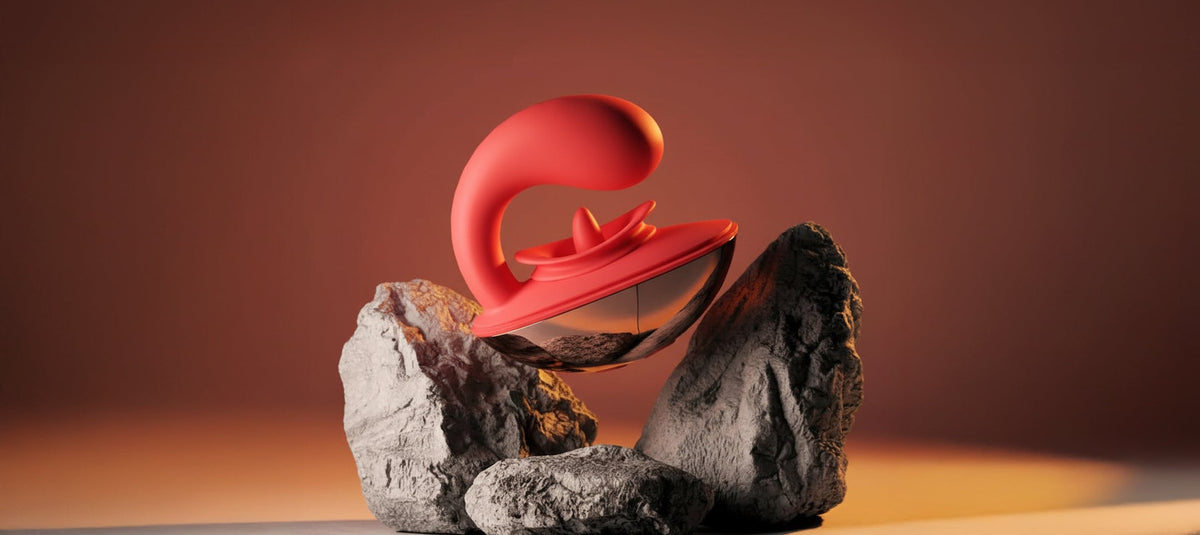
If you'd like a design built specifically with this area in mind, our G-spot vibrator collection includes models with different curves, power levels and functions, some with app control so a partner can join in if you choose. One of the most searched-for options built for exactly this purpose is Neya, a vibrator with a curved body designed to follow your internal anatomy and hold steady pressure in this area, with app control included.
And if what you're after is simply taking time for yourself and getting to know your body better, with no specific goal in mind, our article on intimate self-care has ideas for approaching that exploration from a much gentler place.
Frequently asked questions about the G-spot
Does the G-spot really exist?
Not as an isolated, universal anatomical structure. Current scientific evidence suggests that sensitivity in this area depends on how close together the clitoris, urethra and vaginal wall sit, rather than on a separate organ.
Is it the same as the clitoris?
Not exactly, but the two are far more connected than is usually explained. The clitoris's internal root extends into this area, so much of the sensitivity attributed to the G-spot may depend on that same nerve network.
Why don't I notice it when other people say they do?
Because sensitivity varies enormously from person to person, and also depends on the moment, prior arousal and the type of stimulation. Not noticing something specific isn't a sign that anything is wrong with your body.
What kind of toy helps most with exploring this area?
Curved designs, built to maintain steady pressure against the front vaginal wall rather than focusing purely on depth, tend to make exploration easier. You can compare several options in our dedicated collection for this area.
The conclusion that matters
The G-spot isn't a secret button, and it isn't proof that your body is working "correctly" or "incorrectly". It's a sensitive area, connected to the rest of your anatomy, that responds differently in every person. Letting go of the pressure to find something specific and replacing it with calm curiosity is usually the change that brings the most pleasure. If you'd like some help designed specifically for that exploration, you now know where to look.
Share:
ActiveJoy Control Modes: What Each One Does and How to Get the Most Out of It
Long-Distance Relationships: How to Keep Intimacy and Connection Alive Across the Miles